Rotherham United has been a constant in the now three divisions of the Football League since their formation in May 1925. Ninety-Five years later and the Millers sit second in League One awaiting the EFL’s verdict on whether the season can continue after the Covid-19 pandemic halted football across Europe.
The majority of Rotherham’s football history is in the third tier with forty-six completed seasons. However, in twenty-six seasons, the Millers have been competing, and sometimes challenging for promotion, in the second tier. Seventeen seasons have been spent in the fourth tier of English football and, thankfully, Rotherham has never dipped into the National League set up in their history.
They have come close…very close at certain times to exiting the Football League. Rotherham are part of a unique collection of clubs to not reach the top flight, nor dip into the fifth tier since election into the league. The unique group consists of MK Dons (who replaced Wimbledon in 2004), Plymouth Argyle (elected in 1920), and Scunthorpe United (elected in 1950).
Let’s start at the beginning, Rotherham United’s first season, the 1925/26 season. Having been elected into the Third Division North, the Millers encountered the likes of Doncaster Rovers and Rochdale, as well as some clubs you might not have heard of, such as Nelson and New Brighton. A respectable fourteenth place finish in Rotherham’s first Football League season, gaining forty-one points. Wins are only worth two points until 1981/81!
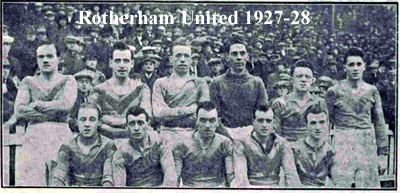
(Sheffield Daily Telegraph 16th Jan 1928)
What followed soon after is the Millers’ lowest finish, twenty-first in the basement division. At this point in English football’s history there is no Fourth Division, so clubs finishing twenty- first and twenty-second in Division Three North and South risk failing re-election for a new, up and coming club. Fortunately, the Millers succeeded in their re-election and held their place. This is the first and only time Rotherham had to re-apply for their football league status. The 1933/34 season was Rotherham’s worst turn over of points in a season for a vert long time; we’ll tough on this again later. A total of twenty-eight points (thirty-eight in new money)
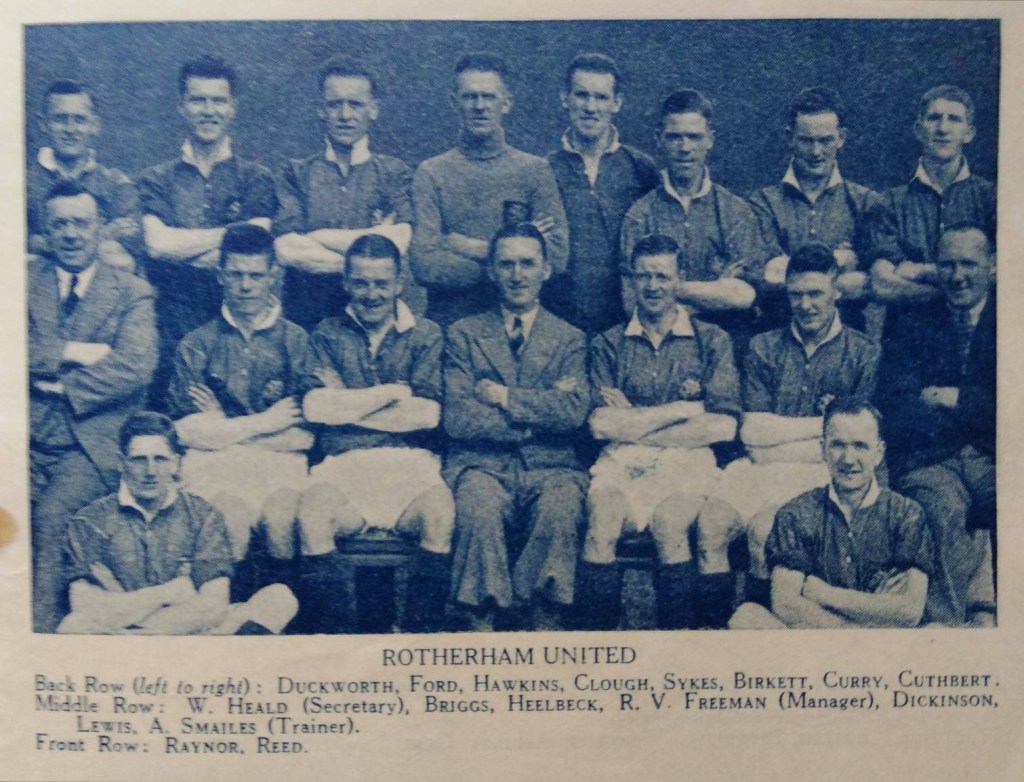
(Graham Barnes collection)
After the Second World War the Millers experienced a run of form which is arguably the best in the clubs history. Having finished second in the league three seasons in a row, and a slight blip of sixth, Rotherham won the Division Three North title with what should be considered the clubs record number of points… if we count three points for a win that is, the Millers accumulated One Hundred and Two points. However, with only two points for a win, the total is a less grand seventy-one.
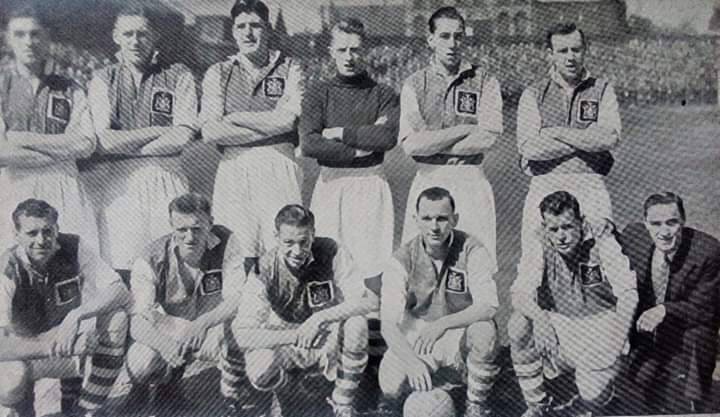
(Graham Barnes collection)
Seventeen seasons in Division Two passed, including the highest ever finishing position for the Millers, where they missed promotion to the First Division by goal difference. Luton Town and Birmingham City pipped Rotherham in 1954/55 and denied them the chance to play with the ‘Big Boys’ in league football. The longest stint in Division Two came to an end in 1967/68 having gone through three different styles of home kit and a gruelling away campaign of three wins and a 6-0 thumping by Queens Park Rangers, the Millers found themselves back in the now nationalised Third Division. At least they had another Division to cushion the fall. Well, that cushion only kept the Millers up for another five seasons until they suffered relegation to the Fourth Division for the first time, on goal difference of all things. Eighteen years after missing the First Division by goal difference and it was the same measurement that condemned the Millers to the new basement division, a cruel turn of fate.
The Division Four hangover only lasted two seasons and in 1974/75 the Millers won promotion, in third position, back to Division Three. Another two seasons past and Rotherham missed promotion by goal difference, again, but it proves to be a huge knock for the squad as the following season they plummeted to twentieth. After a brief stint in mid table, the Millers won the Division Three title in 1980/81, with the likes of John Breckin, Ronnie Moore, Rodney Fern, and Tony Towner in the squad. The title was secured on the final day, a 2-1 victory over Plymouth Argyle at Millmoor. A pitch invasion followed, as you’d expect, and players returned to the dressing room light of their shirts, socks, anything that jubilant fans could get their hands on.
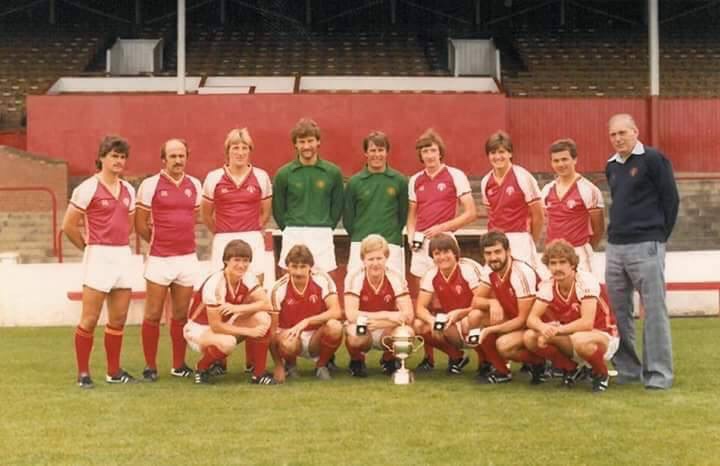
(Graham Barnes collection)
Upon returning to Division Two, the football rules changed as wins now counted for three points instead of two. The next season saw Rotherham finish twentieth and return to Division Three and five seasons later flirted with Division Four again via a short lived idea of the highest relegated team take part in the lower divisions play-off system. Rotherham lost to Swansea City over two legs at the semi-final stage and suffered relegation back to the basement division.
The Millers then won the Fourth Division title, followed by a ninth place finish, then relegation, and then another promotion, then a brief spell of mid table finishes, then suffering a further relegation in 1996/97. The blood pressure of Millers fans wasn’t helped by the club during this period as a play-off final loss, now consisting of clubs from the same league, and a double promotion, the first in the clubs history. With legend Ronnie Moore at the helm, the club finished second in Division Three and then second in Division Two to reach Division One! Remember this is now the era of the grand show that is the Premier League, so Division One is technically Division Two, etc. It’s confusing, isn’t it?
A survival on goal difference, this is becoming a trend, and a few mid table finishes saw out the last time Rotherham played host to Division One football. Now known as the Championship, the Millers finished in last place and now found themselves in League One. What followed is considered by many to be the closest the community of Rotherham as come to losing its football club.
In early 2006 the Millers had a funding gap of roughly £140,000 per month. One major issue was the lack of tangible assets. Millmoor had been purchased by the adjacent scrap yard owner in return for clearing the clubs debt, a reported Three Million pounds. A campaign by the fans known as ‘Save our Millers’ was formed with the aim of raising One Million pounds needed to complete the 2005/06 season. The new Main Stand of Millmoor was estimated at another Million pounds, but that could wait, they needed to finish the season.
A huge ‘thank you’ is owed to rivals Sheffield United, who paid the full wages of on-loan players and donated the profits of the South Yorkshire derby beam back to Bramall Lane. Many other clubs held collections for the Millers to get the season completed. At the eleventh hour a consortium of local business men averted the demise of the Millers and outlined a new business plan. Things started to look up, briefly, as the final game of the season saw Rotherham draw with MK Dons and a draw between Hartlepool United and Port Vale kept the Millers up, just.
Rotherham started the next season with minus ten points. A Creditors Voluntary Agreement was signed to save the club from liquidation. Results on the pitch brought the club out of the relegation places by the end of October, the need for money saw the club lose high profile players and by the end of February the club sat thirteen points adrift. The club was subsequently relegated to League Two. A string of wins and good results saw the club in the promotion places towards the end of 2007, but the dark cloud of administration loomed over Millmoor again. In March 2008 Rotherham was hit by another ten point deduction for entering administration. An eventual ninth place finish was a slight bright light on a financial storm.
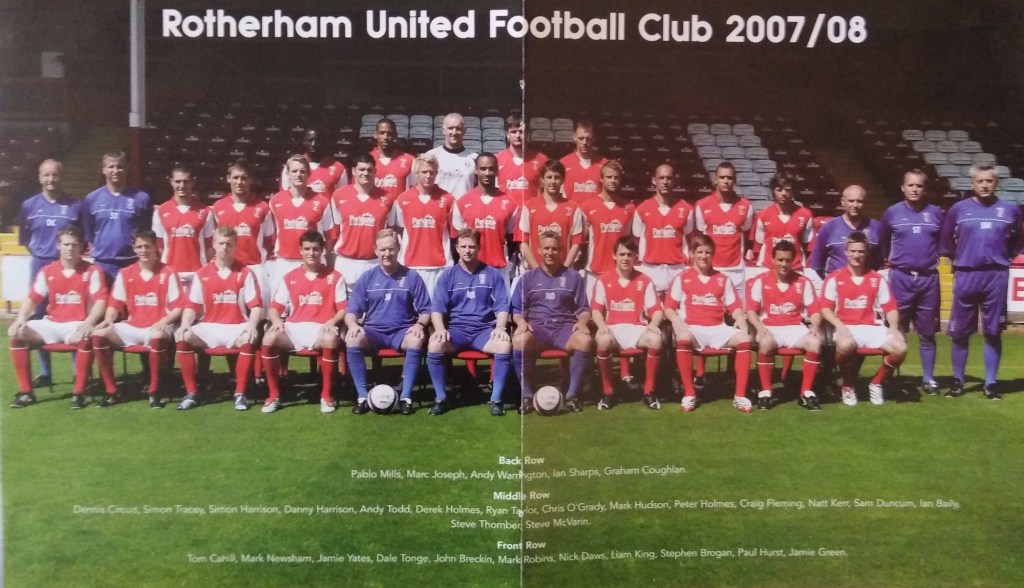
(Graham Barnes collection)
The name, Tony Stewart, is synonymous with Rotherham United these days, but before the 2008/09 season he was the new chairman and club owner. But, the start of his tenure as Rotherham’s chairman was hit with a minus seventeen point deduction for not taking out a CVA to exit administration. Three days before the first kick off, the Football League threatened to block Rotherham, and Bournemouth, from taking part in League Two, effective expulsion from the league. The FL issued the threat as the club had not exited administration or completed the transfer of ownership to Stewart. The points deduction was the only way Rotherham could remain in the league. Squeaky Bum Time doesn’t do this period justice. But it gets worse, a dispute with the owners of Millmoor forced Rotherham to move away from their spiritual home. Increase in debt reason one. The Football League then demanded a bond of £750,000 for the club to play their home matches outside of Rotherham itself. Increase in debt reason two. This forced the club to sell the training ground and rent out a pitch at rivals Doncaster Rovers new Keepmoat Stadium complex.
The Football League then issued Rotherham United an ultimatum. Return to the town within four years or be expelled from the league. Rotherham had to build a new stadium within that time period to keep their football league status. In the meantime, Don Valley Stadium, in Sheffield, would host the Millers’ home games. They quickly wiped out the FL’s point deduction and challenged for a play-off place until the end of the season. The Millers also reached the Football League Trophy Northern Final and the last 16 of the League Cup. Rather impressive for a club steeped in debt and playing outside of the town.
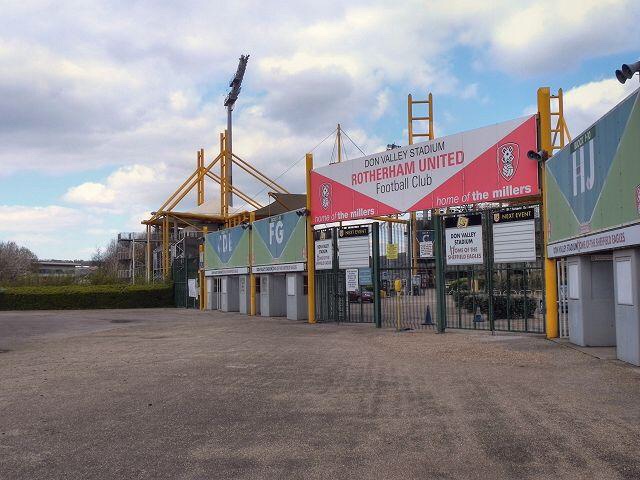
(https://www.glassdoor.co.uk/Photos/Rotherham-United-FC-Office-Photos-IMG168522.htm)
The 2009/10 season brought two delights to Rotherham United. The first came in January when a site was announced to house the Millers’ new stadium. The former Guest & Chrimes Foundry in the town centre. The second came at the end of the season when Rotherham reached the play-off final, their first visit to the new Wembley. Unfortunately, they lost the final 3-2 against Dagenham & Redbridge, but it was a sign the clubs fortunes were turning.
The Millers returned home for the 2012/2013 season, the final year of the Football Leagues deadline before expulsion. Again, squeaky bum time, but it proved to be somewhat worth it as the Millers won a second set of double promotions and haven’t returned to the Fourth tier of English football since. A second place finish lifted the club from League Two in Rotherham’s best points haul in a single season. The second promotion came in the play-offs of League One. Alex Revell’s wonder strike and the following heroics of Adam Collin in the penalty shootout brought the Millers back to the Championship
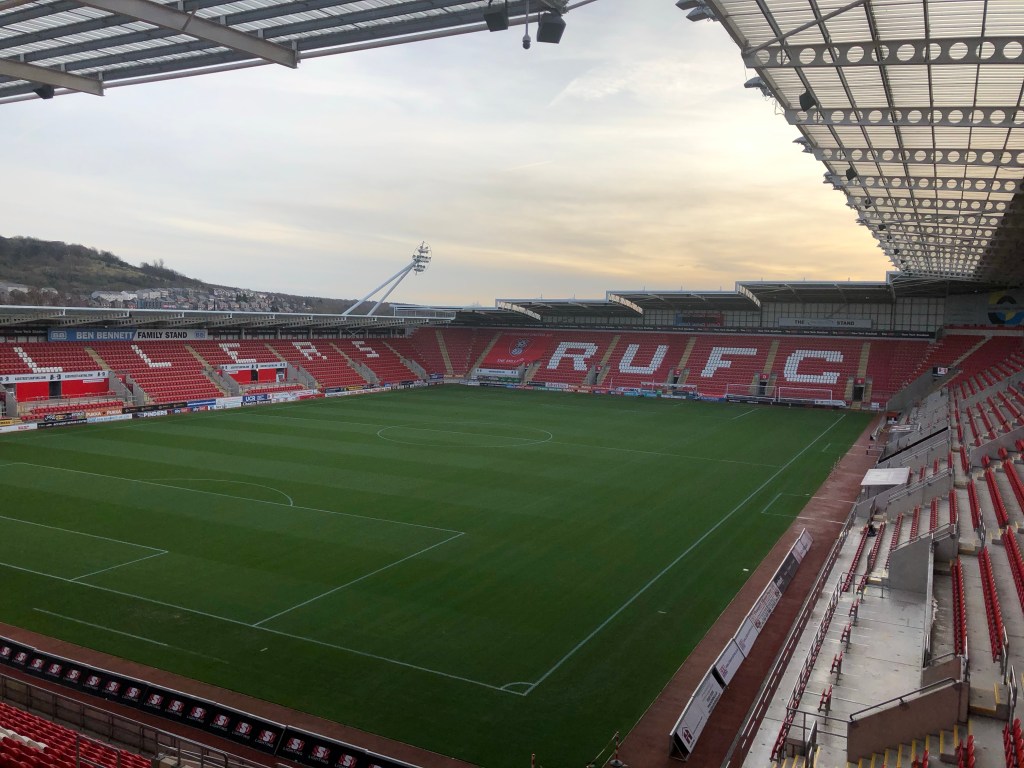
(my own image)
The club did suffer a blip in 2016/17, well a big blip, the worst season results wise in the Millers history. Twenty-Fourth in the Championship doesn’t sound too bad, until you look at the form. Only five wins, twenty-three points all season, and finally ninety-eight goals conceded with a goal difference of minus fifty-eight… not very positive reading. But the club have entered another yo-yo period, echoing the late eighties and early nineties, however there is a difference between the two. The last yo-yo came between the Third and Fourth tiers. The current yo-yo is between the Third and Second tiers.
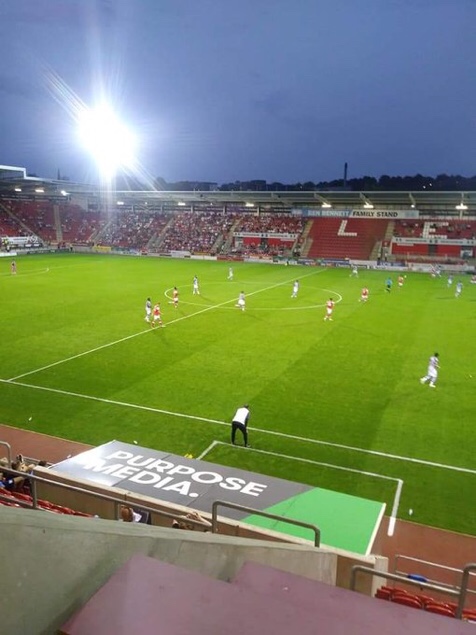
(Russ Vernon)
Rotherham’s football league story has come close to ending on two very different pages, but despite the hardships, the club continues to power on into the second decade of the twentieth century, soon to be the Millers’ own century, their story can be rather beautifully summed up by a lyric from Danny Cannons 1980 Rotherham United record, Miller Men
“The more they try to put us down, the more we’ll rise again”
 The Wandering Yorkshireman
Great research Danny, interesting read:)
LikeLike